All of my life, since I was a little girl, I had felt that I was, or wished I was, a Native American. I absolutely devoured every book on the subject that I could get my hands on. The woods around my rural childhood home, if ever excavated by archeologists, would cause quite a stir. They would be puzzled by the remains of hobbit-sized, eastern woodland wigwams, fire pits, badly made stone tools, and woven mats. I learned many of those skills from books, but it seemed like something I had innately known, and I was reading to learn how to do them properly. I spent almost every weekend with my French Canadian Grandfather, who never said a word about being Metis or Mi’kmaq, but taught me our basic spirituality and stories as he knew them, from his own cultural context. At the time, I thought it was just Catholicism. But now, later in life, I have discovered that it was very similar to the Anishinaabe Seven Grandfather Teachings. He taught me about nature and love of the land. How sacred the animals and forests are. Throughout my adult life, I informally studied mostly fragments of Wampanoag, Nipmuc, and Abenaki teachings and technology. Woodworking, signs left on the landscape, to show travellers the way. The names of places and things, and their meanings. The people who walked these lands, generations ago, became no longer so distant. They were still with us. But distant to me in another way, as I felt like I were sort of a bastard child of invaders. So the more admirable parts of my life, when I was not drunk and miserable, that is what occupied my mind, my soul, and my time. And it is what led me to believe, in spirit at least, that perhaps I was indigenous. At the time, nothing in my family tree suggested any factual basis for this.
Until a very few years ago, I really did not know much about my family’s history. My parents had zero interest. They were Americans. They loved the Beatles and cars, and a big house, and stupid TV shows, and all the things modern people are supposed to want. My Grandparents were traumatised. They escaped a miserable, impoverished life in all of places, Canada. I was never told of our amazing history as Acadians, of our amazing society, of our tragic genocide, or of our mixed Mi’kmaq heritage. I knew nothing of the Acadian kids being denied schooling, and the Mi’kmaq kids being rounded up into residential schools. A parallel and brutal erasure of a ‘problem people’. I learned from my Uncle that my Grandfather, as a child, was surrounded by a mixed Metis society and that parts of his family lived in nearby wigwams. My great-grandfather “played fiddle at powwows”. I received only fragmented memories, teachings, mostly disguised as something else. Or maybe, in my Grandfather’s mind, it wasn’t interesting or cool. Just commonplace, and maybe embarrassing. Country. Hick-like.
At this late time in life, I am putting it all together, all these fragments, filling in stuff that had been missing in me. If you had asked me why I felt like I was indigenous, even just a year ago. I would point to all of that as proof somehow. But especially over the last year, my thinking has changed a lot as I’ve learned more important things. The more I find out about my ancestry, and feel that I have a “solid claim”, the less important it seems to me to prove anything to anyone. I see every day, in indigenous groups, so much fighting, and hatred, and especially all the “pretendian” hunters. Having felt like an outsider for so long, I actually feel more in solidarity with fellow seekers, being rejected and labelled “pretendians”, than any desire to be privileged and accepted. People should be helping others find their way home, not slamming the door in their faces.
I will simply state some things that I believe and have come to realise.
- I am already home, and have always been. I love and belong to the land, right where I am. When I look out to the mountains, I see the young mother in the landscape. When I see our river, I see it as long ago, with salmon and sturgeon leaping through the falls, as it has always been, and will again.
- My people are all around me, diverse people of all colours, many refugees or displaced indigenous peoples from other lands. I work all day with many of my elders. I care for them all and feel responsible to them. This is home.
- My own heritage, as that of others, is a precious gift that must not perish, and is a gift to our children and those who come after. It is not for us to hoard. We are carriers.
- We are all human beings, children! Put here, where we are, by our creator. We are here to help each other, learn from each other, and walk together in a good way.
- I do have nostalgia and a romantic notion of the past. But I am a futurist. And if I am any kind of Puoinaq or prophet, I firmly believe that all of us, together, will find our way back to the circle. And then everyone will truly be indigenous, belonging to the land and each other. Our grandchildren or great-grandchildren may see this day. This will not be returning to the past. This will be a future in balance.
- Our current culture, all of our cultures, are sick. Forces drive us apart. We try to fill ourselves up with stuff… more food, sex, alcohol, drugs, buying lots of stuff, bigger houses, fancier cars, money money money. We are the richest we have ever been. And no one is happy. We have to work to heal ourselves and those around us.
That is not everything that I believe, but it is what is most relevant today, to the question: “What makes you think you are indigenous?” Way more important than whatever my DNA test or quantum might turn out to be, or whatever amazing Mi’kmaq people I find in my tree. At this point, I am not very inclined to tell you. I am not a fucking prize poodle. The above list describes what I am about.
Wela’lin – Miigwech – Merci – Thank you
Hyacinth Jean – Friday the 13th – 2026
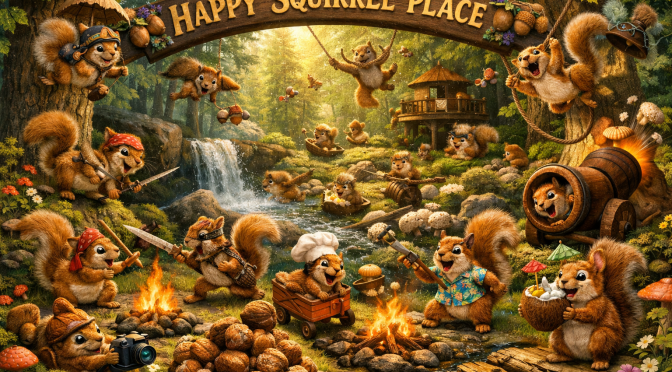
Minwendaagozi-ajidamoong
(happy squirrel place)
