In the first week of August, I made a pilgrimage to my family’s homeland. It was mostly a whirlwind drive around the stunningly gorgeous landscape of New Brunswick and Gaspésie (Gaspe’ Peninsula). We covered over 1000 miles in a few days, trying to see absolutely everything. I saw the towns my family founded and lived in for generations. Found the graves of so many of my relatives, in French settlements as well as in a Mi’kmaq community. Life and the landscape are so different; I have still not adapted to life back home in New Hampshire. My dreams at night are consumed by the place, and I wake up disoriented, wondering where I am.
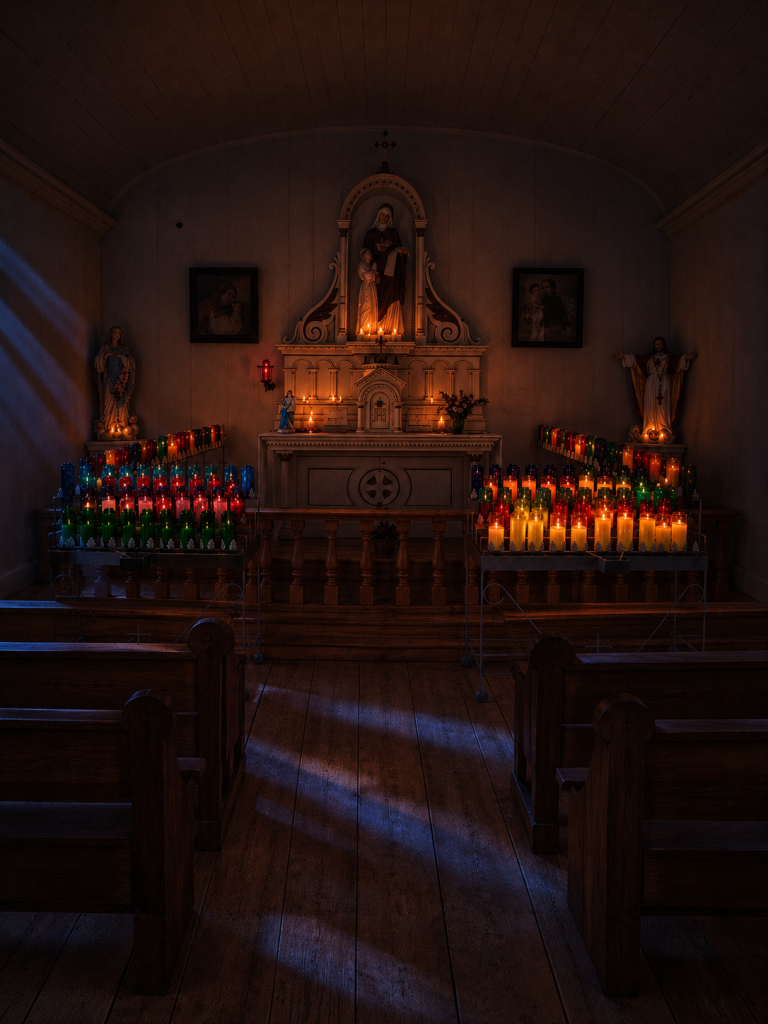
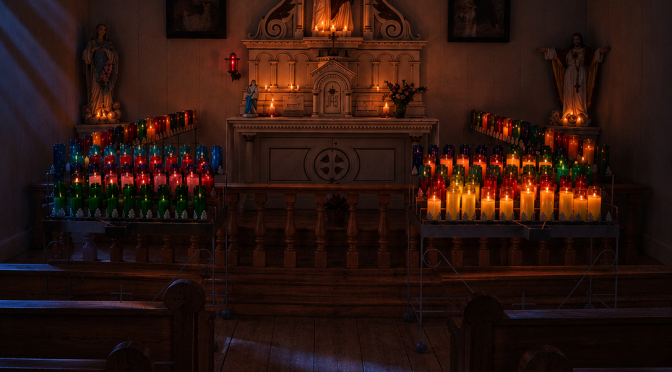
The experience that most profoundly affected me was our visit to Saint Anne du Bocage, in Caraquet, New Brunswick. It was built by my 6th-great-grandfather, Alexis Landry, in the late 1700’s. To this day, the doors stand open, and it is considered a very sacred place to so many. I am no longer a practicing Catholic. But the moment I walked in, I was overcome. I sat in one of the pews and cried for a very long time. It has taken me some time to digest, and start to understand what I was feeling.
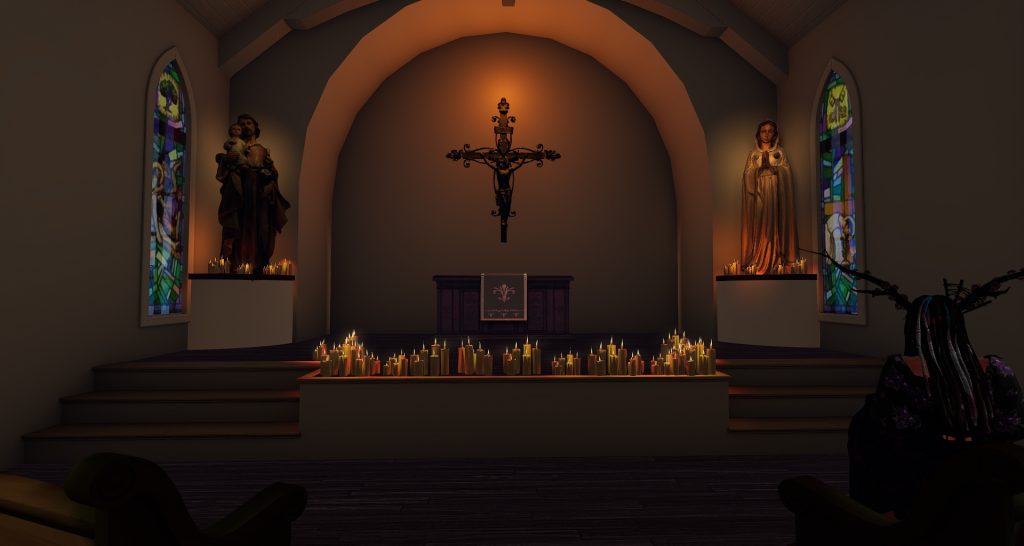
My avatar in our virtual world chapel, trying to figure it out…
I have spent the past few years building a family tree. Building a mental picture of people’s lives. Reconstructing the bits of me encoded in names, dates, places, occupations, even how many cows they owned. I had never understood, really considered them family, loved ones, until I sat in that chapel. Every single one of my great-grandparents had sat where I was sitting. And had felt the way I did right then, in that sacred place, at that moment. They are all present there, with me. I understood their faith. The joy they felt, despite hardship. Their peace in the rhythm of life all around them. My ancestors did not write a lot. I have no books, or letters written by them, all those generations ago. They simply experienced life. And this was the only way and place in the world where they could speak to me. And it is beginning to explain so much about my life, and the longings I have for a home that I never really knew.
I grew up Catholic and was deeply devout as a kid. My Grandfather would bring me to church every Sunday and teach me what he knew of our faith. As I grew older, we moved away to a different town. The Catholic churches that we attended were so different. A lot of rules, a lot of talk of hell. I drifted away. Then later in life, I came to associate Catholicism with all of the horrors we hear about every day. The sexual abuse. The hypocrisy. The atrocities committed against Indigenous children in residential schools. There is a huge disconnect between the religion I grew up in, and the church that I see in the rest of the world. I do not believe that I was simply seeing it through the innocent eyes of a child. The religion I grew up in was truly different. It was a very old and different form of Acadian Catholicism still practiced by immigrants like my Grandparents. It was nurtured in isolation from all the wars and evil in Europe, and by kindred Mi’kmaq people who shared and shaped our faith, and in a lot of cases, became our family.
For the past few years, I have been taking a deep dive into honoring and learning about my Mi’kmaq ancestors, who were not just a single ancestor, but a steady presence in our family over the generations. Traditionally, they have been very devout Catholics, blending Mi’kmaq beliefs with those of the church with little contradiction. I had a hard time coming to terms with that, thinking, as most people would, that they were coerced or forcibly converted. I learned that for so many generations, the Mi’kmaq and Acadians lived in peace and real friendship.
This year, I was invited to attend Red Lake Nation College. It is an Ojibwe tribal college. I am NOT Ojibwe, but I find that we have so much in common. They are honestly the most naturally good-hearted people I have ever met, not only at school, but in everyday life. At the core of their beliefs (and mine!) are the Seven Grandfather Teachings. I will not enumerate them here. But at their core are love, forgiveness, humility, kindness, the interconnectedness of all of us and our world, truth, not only speaking the truth, but living it as well. When I first read of them, in so many words, I found that I had already known them. My Grandfather knew them and lived them. It was at the heart of what I learned at church as a kid. Something that seemed absent from other Catholic churches, doctrine and practice, I experienced later in life. How can this be?
I learned that the Ojibwe, far away from the Mi’kmaq and Acadians, had also experienced a parallel history of friendship and good relations with the French. Many intermarried, their families forming the Métis Nation of Canada. Many Ojibwe adopted Catholicism. And for some, their faith endured, even after the horrors of the residential schools. It being a blend of their traditional beliefs and those of the church.
Even in the face of what we know of history, I have a pretty radical proposal to put forward. European missionaries “converted” indigenous peoples all over the world, mostly through force and coercion. But in the case of the Mi’kmaq and Ojibwe, they were the ones who converted the Europeans and profoundly changed them. I can not speak for Ojibwe or other Mi’kmaq, for that matter. But I can say that the faith that I was raised with bears very little resemblance to any other that I have seen or experienced in the world. And when I sat in that chapel, I remembered. And in that moment, I understood what was in my ancestors’ hearts. They had a deep faith and reverence for creation in everyday life that sustained them, that transcended what we see as organized religion. I also understand that many today will disagree. And that is ok. This is my own journey, with my own family.
That being said. Any devout Catholics reading this will be dismayed that I am very unlikely to return to Catholicism. But, like the Vampire Lestat, in the Anne Rice novels, you might see me lurking in the back of the church. With a broken heart, and longing for a home I can never return to.